


In most AI content tools, rejecting a draft does nothing. You thumbs-down, the suggestion disappears, and the next request comes back with the same blind spot.
At best, a human notices the pattern and hand-edits a prompt somewhere. The single richest source of signal in the entire product, a brand expert telling you exactly what is wrong, is discarded the instant it is given.
How it is done today, and why it is weak
The industry treats generation as a fire-and-forget request: prompt in, draft out, human fixes it manually, repeat forever. Feedback is either binary and inert (a thumbs-down that trains nothing) or trapped in a human's head and applied inconsistently.
Free-text feedback, where it exists, is rich but unstructured, and unstructured feedback does not train a system. "This feels off-brand" is true and completely unactionable to a model. So the same mistakes recur, and the tool never actually learns the brand.
Why we think this is worth getting right
Respecting a brand means learning its taste precisely, not approximating it. Every rejection is a labeled example from the one authority that matters, the brand itself, telling you where the line is. If you can capture that judgment, structure it, and make it durably constrain future generation, the system stops being a generic writer and becomes this brand's writer. That compounding of taste is what makes autonomous generation safe to trust, and it is impossible if you throw the signal away.
How LTV.ai approaches it
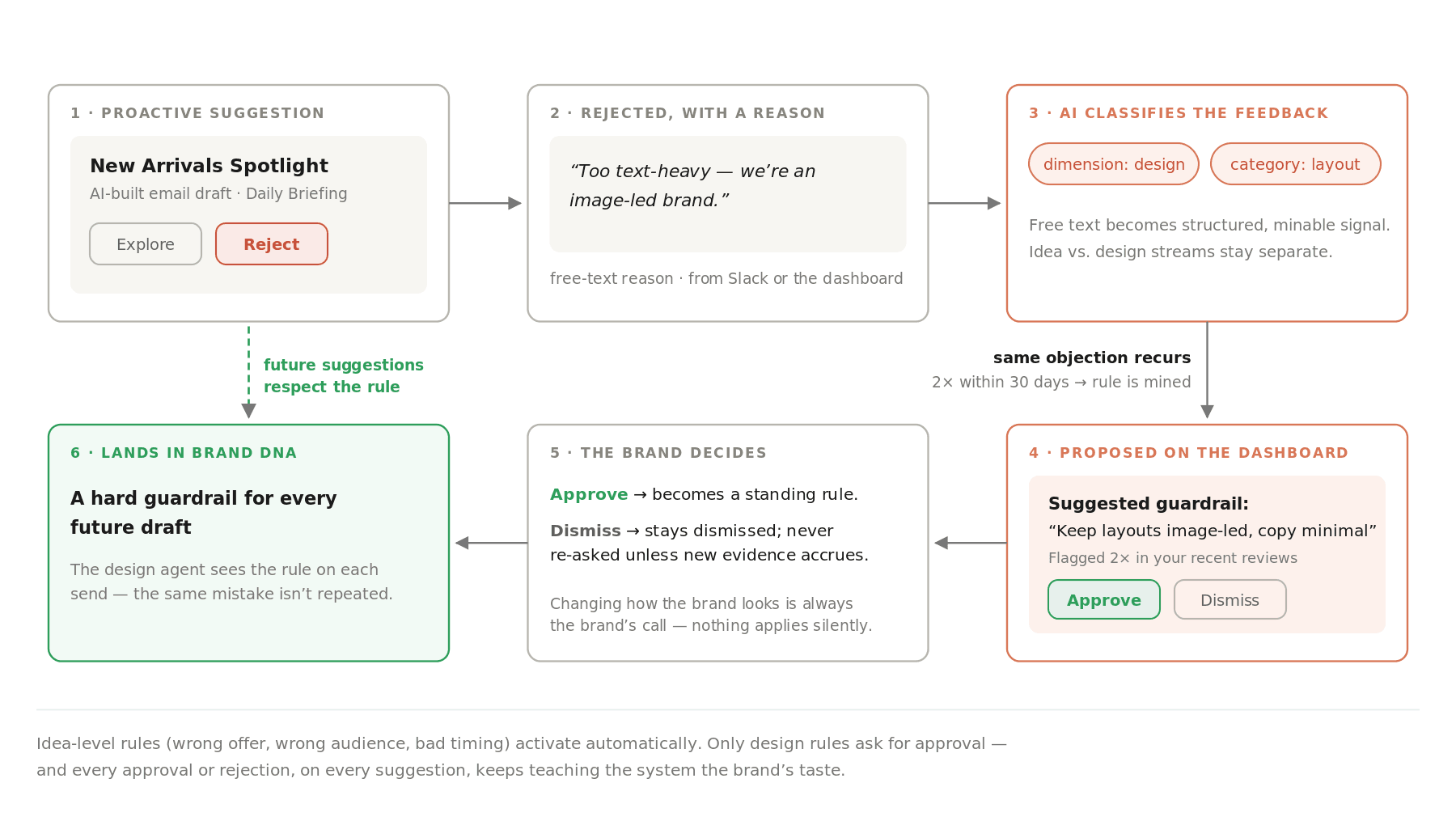
Every rejection is classified along two axes: was it an idea problem (wrong concept, offer, audience, or timing) or a design problem (layout, imagery, products featured, copy style), and which specific category within that. "This feels off-brand" becomes a labeled data point instead of a shrug.
The two streams are deliberately kept separate, because they train different systems. Idea feedback shapes what gets proposed; design feedback shapes how it gets built. Idea rules feed only the ideation prompt, and design rules feed only the design agent. So a complaint about a cluttered layout never distorts which campaigns are suggested, and a rejected promo concept never changes how emails look.
When the same objection recurs, the system proposes a durable guardrail, a plain-language rule the generator must respect from then on. Reject two sitewide-discount ideas with "we only ever discount bundles," and future briefings stop proposing sitewide sales. Flag two drafts as too text-heavy, and a design rule is drafted: keep layouts image-led, copy minimal. Other real examples: never feature clearance items in the hero, do not target recent purchasers with winbacks, avoid countdown-timer urgency.
The two streams also earn trust differently. Idea-level rules take effect immediately and silently. Design-level rules are surfaced for explicit approval before they apply, because changing how a brand looks is the brand's call. Pending design rules appear on the brand's Brand DNA page (and as home-page suggestions), each showing how often it was flagged, with Approve or Dismiss. Once approved, a rule is written into the brand's standing instructions as a hard constraint the design agent sees on every single draft, alongside the recurring complaints it should avoid and what performance data says works.
Dismissed rules stay dismissed unless new evidence accrues, so settled decisions are never re-litigated. Approved ideas flow back too, as positive exemplars: more in this spirit.
How it stays honest and compounds
These mined rules are one layer of the evaluation stack described in the umbrella, and everything they capture lands in Brand DNA. That is literal, not a metaphor: approved design rules live on the brand's Brand DNA page, the actual surface where a human approves them. So each briefing is generated against a more accurate picture of the brand than the last. The reviewer is not just approving campaigns, they are training a model that gets measurably more on-brand with every decision.
Frequently asked questions
Do I have to justify every rejection? A quick reason is enough, and each one improves future output.
Does rejecting slow the system down? The opposite. Rejection is how it learns your brand.
Part of the machine learning behind LTV.ai.
See it on your store: book a demo.