


Pick any audience, say everyone who bought supplements in the last year. There are a dozen defensible ways to segment it: by what else they buy, by how often they restock, by whether they wait for discounts, by order value, by recency. Most tools make the marketer choose blind, up front, from a menu of abstractions.
The honest answer is that which segmentation is best depends on two things the marketer cannot easily see: the statistical quality of the segments each approach would actually produce on this data, and what this particular campaign is trying to do.
How it is done today, and why it is weak
The standard flow inverts the problem. The marketer picks a segmentation type first, usually whichever one the tool's UI makes easiest, and only then discovers whether the resulting segments are any good: balanced, well-separated, large enough to matter.
Often they are not. A discount-affinity split on a brand that rarely discounts produces one giant segment and two slivers. A seasonal split on eight months of history produces noise.
And no tool asks the more important question: good for what? A restock-reminder campaign and a new-collection launch want completely different slices of the same list. Segmentation menus do not know what campaign you are building.
Why we think this is worth getting right
The right segmentation is often a bigger lever than the copy, but only if "right" means right for this audience, on this data, for this campaign.
A system that proposes segmentations it cannot statistically support would compound its own errors at scale, so the ranking has to be earned, not assumed. Getting this right turns segmentation from a configuration chore into a recommendation the marketer can evaluate in ten seconds.
How LTV.ai approaches it
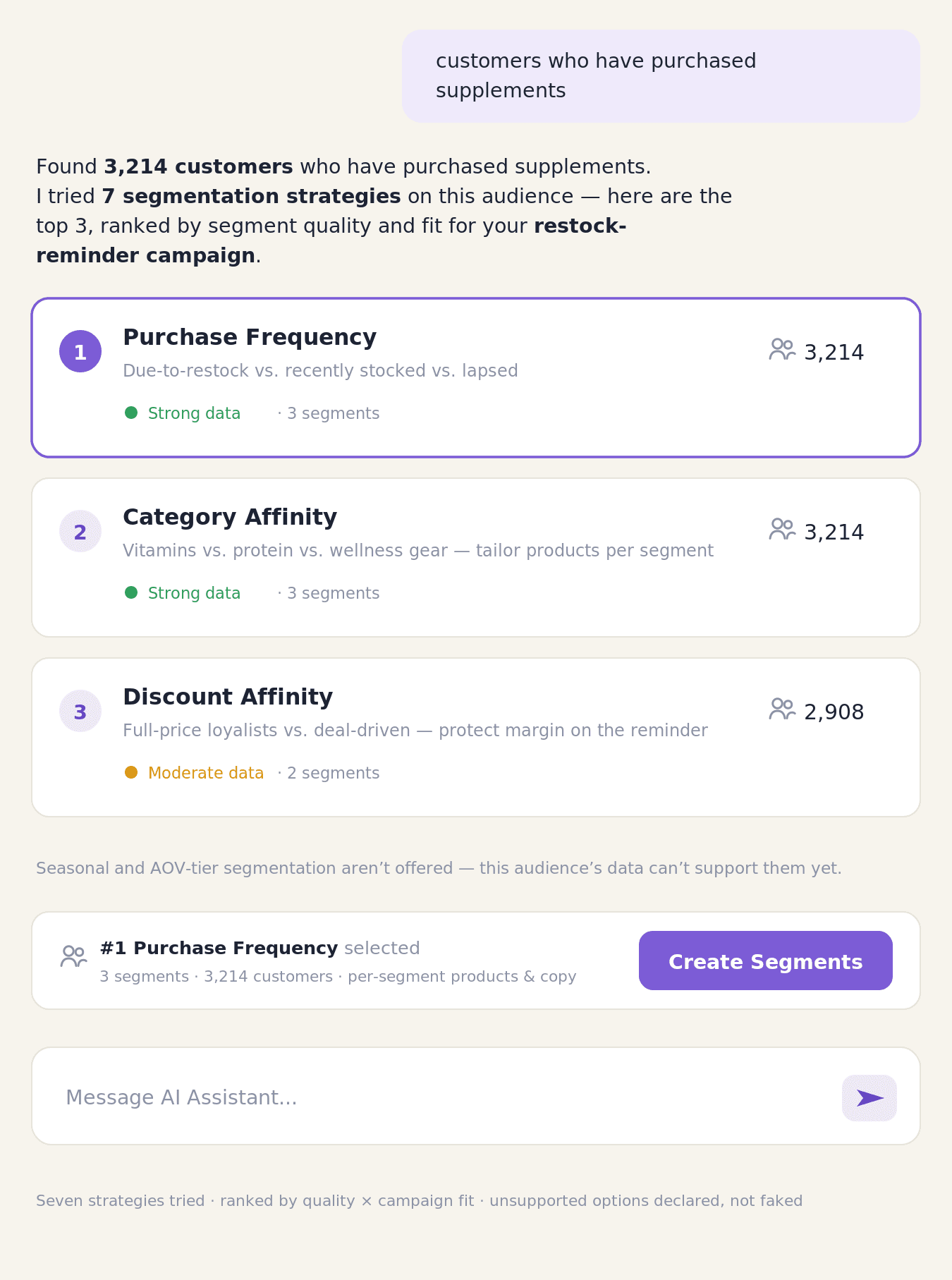
When an audience is selected, the system does not ask the marketer to pick a segmentation type. It applies every viable strategy to that audience, category affinity, discount affinity, purchase frequency, order-value tier, recency, seasonal, and gift-versus-self, computing the actual segments each would produce.
Each candidate segmentation is then scored twice. First on segment quality: does the brand's data actually support it, are the segments balanced and well-separated, is each one large enough to send to? Second on campaign fit: a ranking model reads the campaign's goal and context and asks which slicing serves this send. A replenishment campaign favors purchase-frequency segments; a premium launch favors order-value tiers and full-price loyalists.
The top three land in chat, ranked, each with a plain-language description, live segment counts, and a data-quality indicator, so the marketer picks between three concrete, defensible options instead of a menu of theories. Strategies the data cannot support are not hidden or faked; they are either shown as unavailable or simply not offered.
One click materializes the chosen segments as send-ready lists, and each segment then drives its own product picks and copy guidance downstream.
How it stays honest and compounds
Every ranking is grounded in measurable segment quality, not preference, and the data-sufficiency gate means a young brand is offered fewer, safer segmentations that expand as its history grows.
Because segments are materialized as real lists, what was sent to whom stays auditable. And the same scored segments feed the rest of the system: per-segment product recommendations, per-segment copy, and per-segment performance insights, so a good segmentation keeps paying off after the send.
Frequently asked questions
Do I have to understand the strategies to use this? No. You see three ranked, described options with counts. The statistical vetting already happened.
What if none of the three fit what I have in mind? Describe the audience you want in plain language and the system builds it as a custom segment instead.
How is this different from choosing who to target? This post is about slicing an audience you have already chosen. For how the audience itself gets built and targeted, see how LTV.ai builds audiences.
Part of the machine learning behind LTV.ai.
See it on your store: book a demo.